


IKEA Has a Team Just for Reactive Posts
What IKEA’s Social Media Team Can Teach You About Knowing When to Speak
Crisis Communication Strategies in Action: The IKEA Interview
Introduction by Bruce Hennes, Hennes Communications
Most organizations treat social media as a megaphone. IKEA treats it as a listening post. In this Link in Bio interview, IKEA’s Elissa Wardrop explains how a small team decides, several times a week, which moments in the culture the company will join.
Just as important, it decides which ones to skip, a lesson in crisis communication strategies that reaches well beyond furniture. In her words, ‘Knowing when to stay quiet is just as important as knowing when to join in.'”
Why does that belong in a crisis communications newsletter? Because speed without judgment is how organizations get into trouble. Before IKEA posts, the team runs through a checklist: Could this hurt or exclude anyone? Does it raise copyright or safety issues? Does it fit the brand? Can we say something only IKEA could say? That discipline is the foundation of effective crisis communication strategies. The organizations that handle a bad day best have usually already learned how to decide, quickly and calmly, when to speak and when to stay quiet.
And you don’t need a global brand’s resources. Wardrop says what matters is clear processes, clear guardrails and trust in the people making the call. A school, a hospital, a law firm or a nonprofit can agree in advance on who decides, what the test is and how fast to move.
IKEA Has a Team Just for Reactive Posts
By Rachel Karton, writing for Link in Bio.
A little over a year ago, I asked an important question in this newsletter: Are you a Fast Brand or Slow Brand on social media? The team structure of a brand that wants to be the first to post a meme about Taylor Swift’s engagement looks very different from the team structure of a brand that wants to tell timeless stories. The roles at a Duolingo are different than the roles at a Ffern.
Both of these strategies work, but too often I see leadership of Slow Brands ask their social teams to act like Fast Brands, with no infrastructure in place. They will message their team IKEA’s viral Severance post, for example, and say, “Why didn’t we do this?”
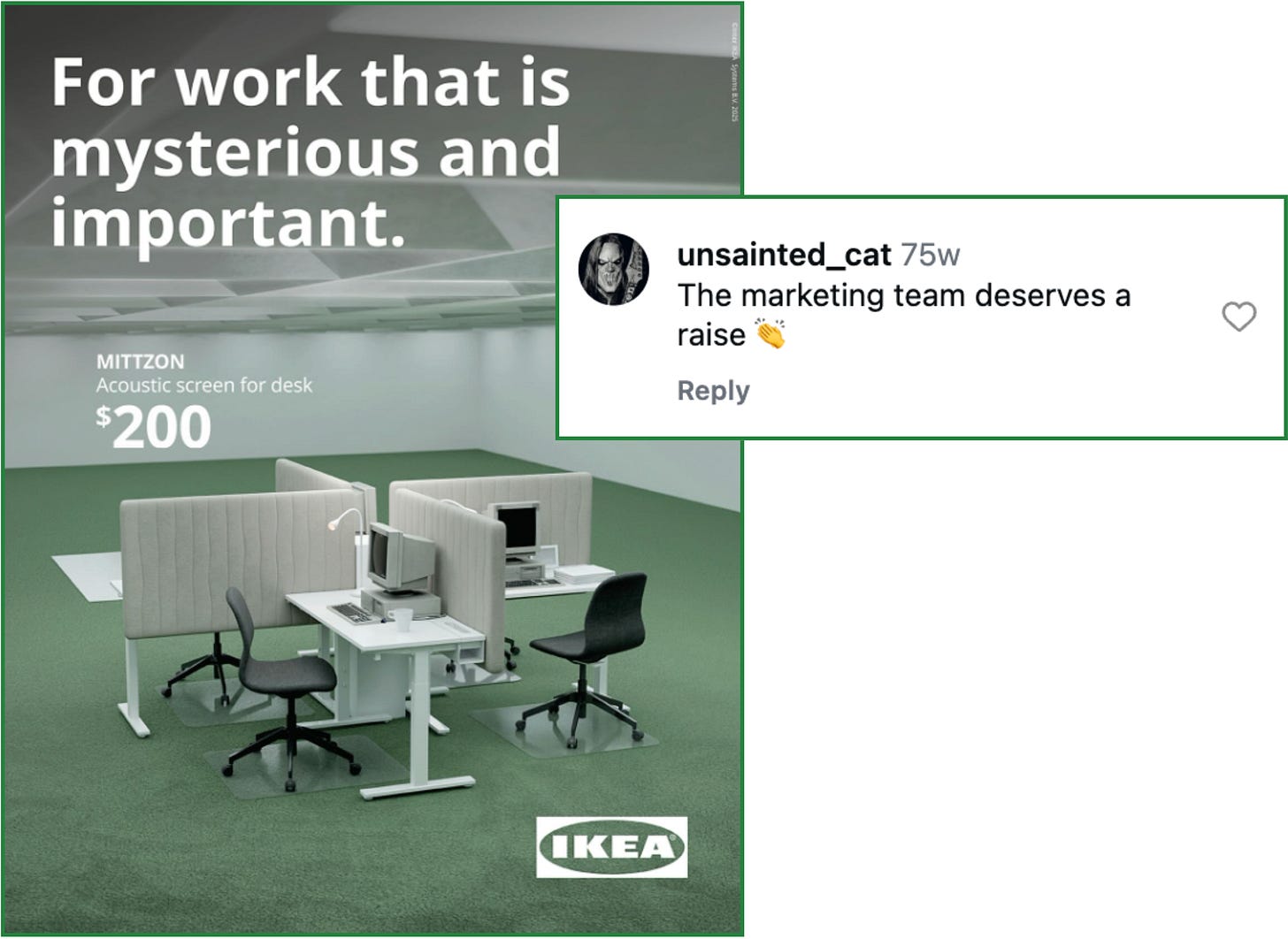
What these leaders fail to understand is that there’s a reason that a brand like IKEA is able to quickly (and consistently) react to culture. It’s because they have an entire rapid response team dedicated to these moments. The Responsive Project Team meets multiple times a week, has a dedicated Teams channel, and runs every post through a checklist to make sure no one comments “silence, brand”. You can thank them for wink-y posts about Zara Larsson and Punch the monkey, with the latter garnering 214K shares and being their most-liked organic campaign of all time.
In today’s newsletter I am talking to Elissa Wardrop, Global Social Media Specialist at IKEA, about the processes it takes to move fast. We talk about the “originality test” she puts every post through, the responsibilities of the Responsive Project Team, and the mistakes she sees brands make when implementing a reactive strategy.
achel Karten: First, can you tell me a bit about your role?
Elissa Wardrop: It’s not a typical social media job…but then again, what is?!
Rather than managing channels, I work across various project teams to shape social strategy and create content for IKEA retail with operations in 32 markets around the world. One of these is our Responsive project team, where I create fast, culturally relevant content around trends, news, pop culture, and key moments.
I also lead our internal social media community across all of our countries day-to-day, which is probably my favourite part of my role. I get to communicate with social specialists all over the world, learn about their cultures, what’s trending in their markets, and constantly share inspiration with each other.
Rachel: How would you describe IKEA’s approach to social media?
Elissa: Human, humble, and unmistakably IKEA.
Our creative direction is built around three words: simple, playful, and inclusive, which I think translate really naturally to social media. We don’t want to overcomplicate things, we want to speak to people like people, and importantly, we don’t take ourselves too seriously.
A big part of that playfulness is what we call the IKEA “twinkle in the eye.” It doesn’t necessarily mean telling jokes or trying to be funny. It can be a clever connection, an unexpected little surprise, or simply a choice of words that makes you grin.
We create everything from deeper, original storytelling to quick responsive content around what people are talking about right now, but whatever we’re creating, the question is always: does this feel unmistakably IKEA?

Rachel: We’re posting at a time when people are very sensitive to how brands engage with cultural moments and trends. There are a lot of “silence, brand” comments. Your reactive strategy avoids that sentiment. I have a theory on why, but what would you say?
Elissa: I think a big part of it is that we don’t feel like IKEA needs to be part of every conversation.
When we do respond, we want there to be a genuine IKEA reason for us to be there—whether that’s a clever connection to one of our products, life at home, the IKEA experience, or our Swedishness.
And importantly, we want to contribute something new rather than just recreate the same trend with an IKEA logo on it. As I always say: we want to innovate, not imitate.
Sometimes the best response is just one image and a few words. And other times the best response is not to post anything at all. Knowing when to stay quiet is just as important as knowing when to join in.

Rachel: Many social media teams have a desire to be responsive but lack the infrastructure to move quickly. What structural meetings, processes, or philosophies do you have in place to enable this responsiveness?
Elissa: We’re lucky to have a small Responsive team that comes together two to three times a week, with a very active Teams chat in between where we’re constantly sharing things we’ve spotted and bouncing ideas around. We’re different ages, nationalities and have different interests, so our feeds look completely different and we naturally spot different things.
For the rest, click here.