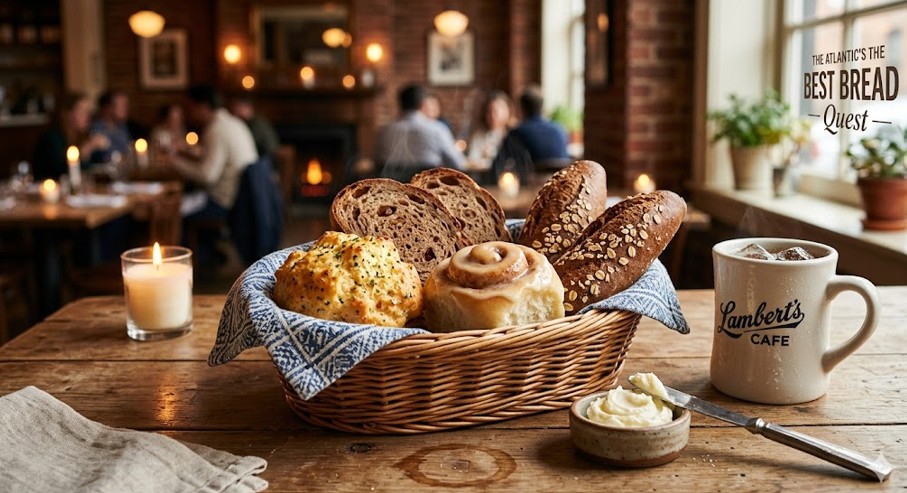
Here is the promise you and I must cling to across the thousands of words that follow: At some point within this text, I will reveal to you what—after 555 responses, 13,000 miles of travel, and months of monomaniacal research—I have determined to be the best free restaurant bread in America. I will not attempt to slither to the moral high ground, arguing that best is a meaningless measure, or insisting that all bread is dear in its own way. Even if you attempt to betray me—for instance, by merely scanning the text that follows for the phrase Here it is: the best free restaurant bread in America—I will uphold my end of the bargain.
I encounter on this quest three types of Americans, because only three types exist. The type that you are—or the type that you are dealing with—is revealed in response to the question “What is the best free restaurant bread in America?”
The American people, alas, have grown skittish about answering plain questions. An unconscionable number ask what I mean by this, as if the words might have an obscure double meaning. To be clear: Any bread from any restaurant in America is eligible, so long as it is free to all customers. The contents of the basket set on the table before the meal arrives, the cost of which is invisibly diffused throughout other menu items. Rolls that arrive unbidden. Popovers, if everyone gets a popover no matter what. You know what I’m talking about. Free restaurant bread.
The first type of American: people who joyride the day’s updrafts like marvelous, glossy crows. They easily recall the locations of treats encountered over their lifetime. They answer this question Glock-shot fast, as if they have been waiting to be asked it. They are happy.
The second type: fairly certain that they have consumed bread at some point; allows that a portion of that consumption could have occurred within the confines of a restaurant, or a restaurant-like environment; will grant that some pieces of said bread were perhaps free and/or enjoyable to ingest. But they profess to have retained no specifics. Their personal histories are inscribed in chalk, regularly power-washed with jets of deterging Time. They resent the implication that they could ever derive meaning from the pale, abstract remnants of narrative that constitute their internal autobiographies, and, with a few kindhearted exceptions, will not attempt to. Many, in fact, will appear oddly furious to have been asked this question, and will invent wafer-thin excuses as to why they are unable to spend two seconds considering it.
The third type: a tragic, paranoid (though occasionally brilliant) figure. Ask this person, “What is the best free restaurant bread in America?” and their eyes shimmer with panic. These individuals live with the terrific knowledge that there is a best free restaurant bread in America, and the awful conviction that they are incapable of identifying it. It is not a lack of contenders that prevents them from volunteering an answer—the prison of their mind teems with memories of free restaurant breads—rather, they are silenced by a hallucinatory fear of nebulous consequences that could befall them should they personally misidentify the best free restaurant bread in America, even in private conversation. Asked this question, such people refuse to answer. “It’s too much pressure!” they insist. Whence this pressure, of what force, applied to what possible end, is never explained. Men and women with advanced degrees are overrepresented in this type.
Though it strikes the ear as an insoluble query, there is a correct answer—right now, known only to God (and to me, an agent of his will), but erelong to the steadfast reader.
Here is where the notion for the undertaking came from: Tucked within the viscera of the continental United States is a restaurant that gives away superb free bread. Every time I have eaten it (before this past year, three times total), I have said aloud (to my husband, who did not care), “This is the best free restaurant bread in America.” The thought made me feel the way you do when you realize you were just a half a moment away from being plowed by a car, and were spared only by a chance nanosecond of dawdling before stepping into the street: giddy and flabbergasted and grateful to be alive. It seemed incredible, but also possible, that this really could be the best free restaurant bread in America. What if it was? Even more dizzyingly, what if it wasn’t? What if—unfathomable—someone else was giving away an even better bread for free? The thought drove me crazy. I begged for the opportunity to investigate.
Naturally, I told my superiors, this investigation would bring me into contact with the entire arc of human history. People have been eating bread—in many places, eating mostly bread—for millennia. We can’t say for certain that the individuals who fled their burning homes on the shore of the Sea of Galilee 23,000 years ago (leaving behind baskets they’d woven, tools they’d carved from bones, and sleeping areas they’d turned snug and cozy) ate bread, but we know from microscopic barley and oat remnants embedded in a grindstone abandoned to the flames that they were, at least, processing flour. (To situate these folks in time: Cats would not be domesticated for another 14,000 years or so.)
Once people began munching bread, they never stopped. (Or, at least, they never stopped until very recently.) The word bread can also refer more generally to food, sustenance, or livelihood—not just in English, but in languages from Russian to Hindi. Breadcrumbs are scattered throughout our language. The word lord is derived from a compound word in Old English—hlāfweard—translating, roughly, to “loaf guard” or “loaf keeper” (breadwinner could be seen as a modern fraternal twin); lady comes from hlæfdige : “loaf kneader.” The arm bones of Neolithic women, researchers have found, were 11 to 16 percent stronger than those of the women’s rowing team at the University of Cambridge, likely from grinding grain for hours every day.
(Of course, eventually, my investigation would lead me back to the site of the bread that inspired it, thereby accomplishing my secret personal mission: procuring a fourth basket of free bread from that restaurant. Unfortunately, what happened to me on my return visit was so shocking and abominable, I was tempted to re-pitch this article as “What Is the Restaurant in America That I Hate, That I Will Never Go Back to, That Has Made of Me an Enemy for Life Due to Its Psychotic Soda Policy”—on which, more upsetting details to follow.)
How would I determine the best free restaurant bread in America? Simple: I would ask every single person I encountered, “What is the best free restaurant bread in America?”; travel to the most likely candidates; and try the bread myself.
The $725.32 Free Bread
Sixteen splendorous bread varieties are yours for claiming off the three-tiered lacquered rolling cart at Joël Robuchon in Las Vegas. You can have as many as you want, all for free, with your meal. My meal was the Degustation Menu, which costs $525 per guest. The breads range from the fanciful (surprisingly pointy bacon-and-mustard pods, heart-stoppingly yellow saffron focaccia) to the nearly indistinguishable (classic baguettes, traditional baguettes). There are flaky spirals and poofy cubes and bread with the gently rounded profile of a tasteful breast implant. There is olive bread; rosemary brioche; basil focaccia; walnut raisin; one miniature croissant; two cheese breads; a third kind of baguette that is exactly the same as one of the other baguettes, only smaller. There is country loaf. Sixteen.
For the rest of this article, please click here.
Photo Credit: Gemini